


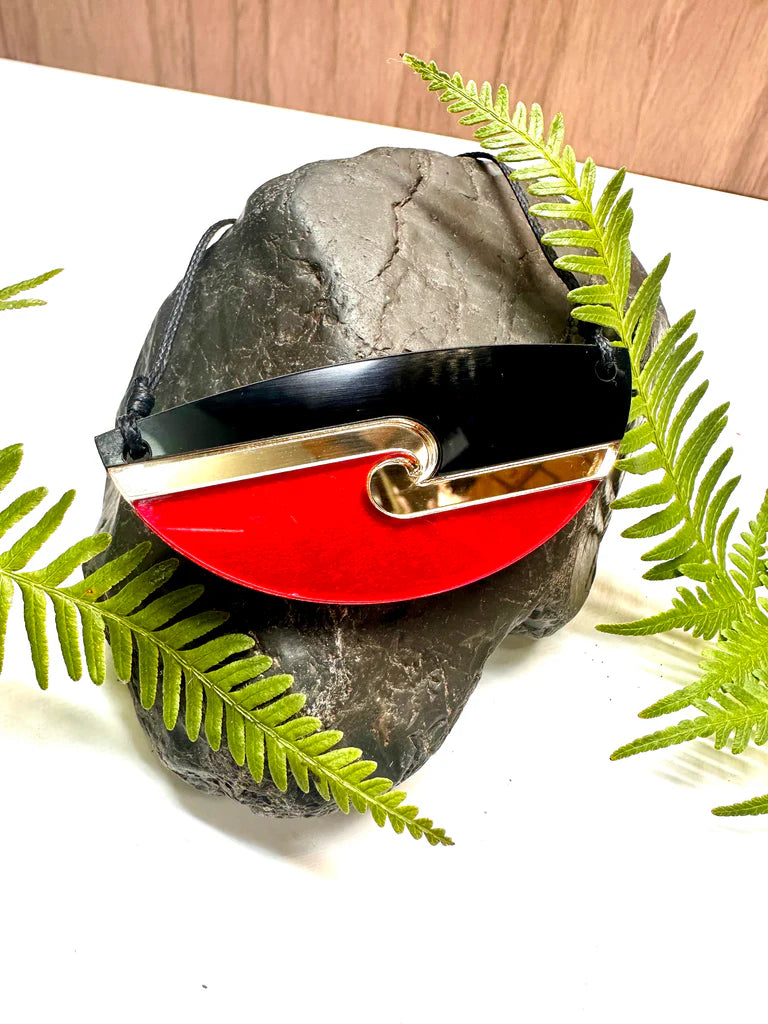
Tino Roa Breast Plate
Couldn't load pickup availability
Any korero about the Tino Rangatiratanga flag deserves to come from the source.
So most of the following text is from the Te Tuhi Mareikura Trust web site
THE STORY
The Tino Rangatiratanga Māori Flag has evolved since its first creation in 1989, and has since become a symbolism of Māori Sovereignty to a generation of Māori who weren't even born when the hake was initiated by Te Kawariki and its members. Tino Rangatiratanga has become an epitome of Maori and their journey for Sovereignty, recognition and acknowledgement of the injustices of previous colonists systems.
THE CREATORS
After being created by Hiraina Marsden, Jan Dobson, and Linda Munn, the flag was then first unveiled on Waitangi Day (February 6th) of 1990 at the 150th commemorations of the signing of Te Tiriti o Waitangi.
THE DESIGN
Black represents Te Korekore the realm of Potential Being. It represents the long darkness, from whence the world emerged. It represents the heavens, the male element is formless, floating and passive.
___________________________________________________
White represents Te Ao Marama, the realm of Being and Light. It is the Physical World. White symbolises purity, harmony, enlightenment, balance and air rising.
The Koru, curling frond shape, represents the unfolding of new life, that everything is reborn and continues. It promises renewal and hope for the future.
The design can also be interpreted as a white cloud mass over Aotearoa.
____________________________________________________
Red represents Te Whei Ao, the realm of Coming into Being. It symbolises female, active, flashing, south, yelling, emergence, forests, land, gestation and spirals. Red is Papatuanuku, Earth Mother, the sustainer of all living things. Red is the colour of earth from which the first human was made.
The design represents the balance of natural forces with each other. To live life is to live with nature. To appreciate life is to understand nature.
Measurement: 9.0cm approx from top of hook to bottom of piece
Materials
Materials

The materials used and sourced for our contemporary designs are as follows:
Lining: Black polycotton blend
Feathers: Our contemporary korowai designs include a variety of colored craft feathers for fashion industry clothing and costumes, particularly hen and rooster coque feathers.
Bands: Our contemporary korowai designs include machine made taniko bands made locally in Aotearoa, New Zealand.
Shipping & Returns
Shipping & Returns
New Zealand Shipping
✨ All orders arrive in our signature Korowai by Hiria gift box.
$10 Flat Rate NZ Shipping (Courier Tracked)
Made to order — dispatches in up to 15 business days
You’ll receive your tracking information via email once your order has been dispatched.
Delivery is typically 1–3 business days after dispatch NZ-wide.
Auckland Boutique Pickup (Free)
✨ All orders arrive in our signature Korowai by Hiria gift box.
Made to order — ready for pickup in up to 15 business days
You’ll receive an email when your order is ready to collect from our Auckland Boutique.
International Shipping
✨ All orders arrive in our signature Korowai by Hiria gift box.
Made to order — dispatches in up to 15 business days
You’ll receive your tracking information via email once your order has been dispatched.
Delivery timeframes (after dispatch)
-
Economy Plus (Tracked): target delivery 3–10 business days - $35.00 NZD
-
Courier Tracked: target delivery 2–6 business days — $50 NZD
If you have any questions, feel free to reach out to us at orders@korowaibyhiria.com
Dimensions
Dimensions
Children’s size guide
Our Baby size is best for 0-12months
Finished width is 50 cm
Our Toddler size is best for 1-5yrs old
Finished width is 60 cm
Our Kids size is best for 6-12 yrs old
Finished width 80 cm
Adult size guide
Length Options:
Measure from shoulder point down the side of your body to choose the best length.
- Cape : 30 cm
- Quarter: 40cm
- Half: 60cm
- Full: 100cm
Korowai Width Sizes:
Measure around your upper chest and shoulders to choose the perfect size.
- Small (to fit 95-105cm)
- Medium (to fit 105-115cm)
- Large (to fit 115-125cm)
- XL (to fit 125-135cm)
- 2XL (to fit 135-145cm)
- 3XL (to fit 145-155cm)
Care Instructions
Care Instructions

To store our Korowai by Hiria designs, follow these steps:
1. Clean and dry: Gently vacuum or brush off any debris. If necessary, hand wash in cold water with a mild detergent, then air dry.
2. Folding: Fold the korowai in a way that minimizes creasing and stress on the fibers. Consider folding it in a way that allows it to be stored flat.
3. Storage container: Use a breathable, acid-free container, such as a wooden chest or a cloth bag.
4. Tissue paper or cloth: Wrap the korowai in acid-free tissue paper or a soft cloth to protect it from dust and moisture.
5. Store flat: Place the wrapped korowai in the container, storing it flat to prevent creasing and damage.
6. Climate control: Store the korowai in a room with a stable temperature (around 20°C) and humidity level (around 50-60%).
7. Handle with care: When handling the korowai, wear gloves to prevent oil from your skin damaging the fibers.
By following these steps, you'll preserve the korowai for future generations.

Proud to be Māori Made in NZ since 2019
Ko Motatau te Maunga
Ko Hikurangi te Awa
Ko Tau Henare te Marae
Ko Te Orewai te Hapu
Ko Ngāti Hine te Iwi